
Interview with Adrian Zeman of Zayed Sport City and Luke Burden of Laykold
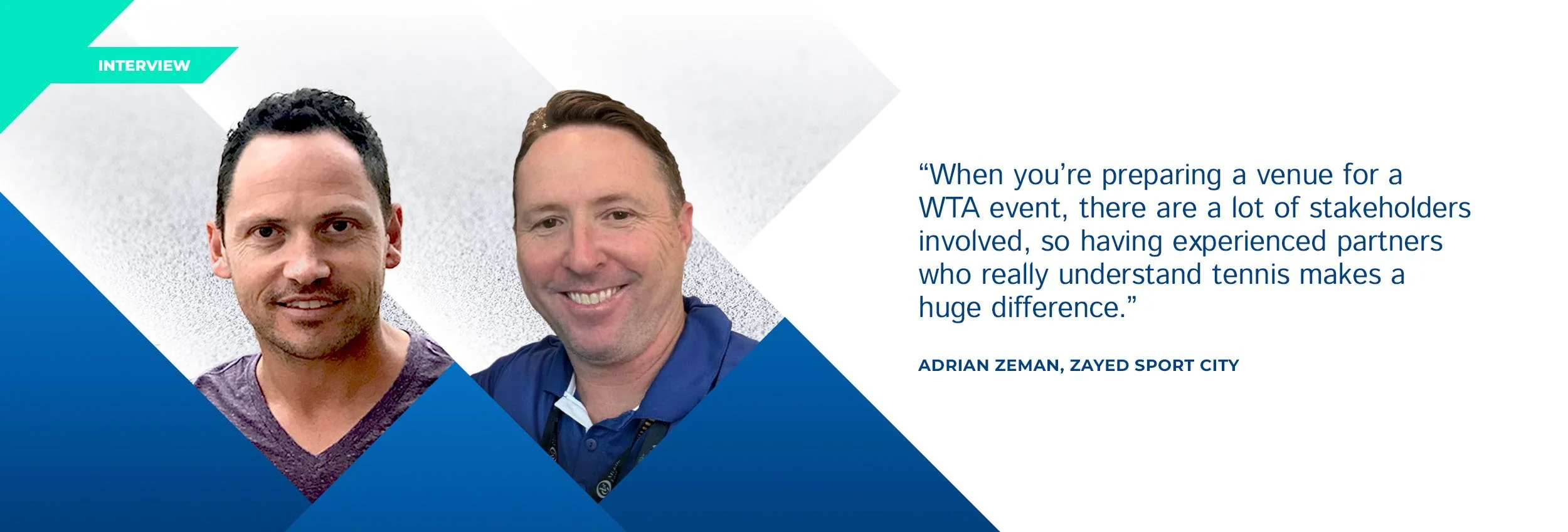
Industry veterans talk tennis, tournament evolution, and building new opportunities for the game.
From AUS to the USA and now the UAE, Adrian Zeman’s journey through tennis has been marked by passion and the love of a challenge. The Director of Racquet Sports at Abu Dhabi’s Zayed Sports City, brings more than 25 years’ coaching, operations, and tournament experience to one of the Middle East’s most ambitious sporting hubs. In conversation with Luke Burden, the pair reflect on shared tennis roots, the sport’s evolving landscape, and building a tennis culture from scratch.
Adrian, were you always a tennis guy?
I’m originally from Sydney, Australia. I actually grew up playing cricket and didn’t pick up tennis seriously until I was about 14 or 15, but once I got into it, it clicked pretty quickly.
My real break came in 1999 when I moved to Texas to intern at the Tennis Ranch run by John Newcombe and Tony Roche. At the time you had players like Lleyton Hewitt and Patrick Rafter playing Davis Cup, and those legends of the game like Rod Laver, Ken Rosewall and Roy Emerson were everywhere.
They were heroes, and they were also incredibly generous with their time and knowledge. That culture of sharing ideas and learning from each other shaped my entire career.
What was meant to be a six-month stint turned into over two decades in the States. I worked my way up through coaching roles, ran adult tennis programs, worked in high-performance academies, and eventually managed major tennis operations.
Luke and Adrian, how do the two of you know each other?
Adrian: Luke and I go back more than 20 years. We met in the early 2000s at Crandon Park in Key Biscayne when I was directing tennis operations connected to the facilities around the Miami Open.
That tournament was actually one of the first times I saw Laykold courts being used at that scale. Back then we were doing everything from setting up event infrastructure to running club operations around the tournament – it was a huge logistical exercise.
Luke: Exactly, those events were where you learned every part of the business. We both came through the industry from the ground up. We’ve done every job imaginable: interns, coaches, sweeping courts in the morning, running tournaments, managing clubs. Even now, if a court needs to be cleaned or prepped, we’ll jump in and do it ourselves. That hands-on mentality has always been part of tennis.
Adrian, what drew you to the role of Director of Racket Sports at Zayed Sports City?
I’d done a lot in the US, like academies, large club businesses, player development, but the thing that eventually convinced me was the challenge and feeling the responsibility to give something back to tennis.
Zayed Sports City is the largest sports facility in the UAE, possibly in the wider Gulf region. Yet tennis here is still developing, and there isn’t the same grassroots structure you’d find in places like the US, so I saw an opportunity.
Tennis here is competing with sports like Padel, which has exploded in popularity across the region. Many parents here never played tennis themselves, and it doesn’t have that generational pull. So we have to take tennis into schools and communities, rather than waiting for people to come to us.
“The courts at MADO were phenomenal and held up beautifully. In a climate like Abu Dhabi’s, with heat and constant environmental stress, the performance of a surface is critical, and Laykold understands those challenges incredibly well.”
How was the recent Mubadala Abu Dhabi Open (MADO), which takes place at Zayed Sports City?
It’s an incredible venue. The scale of the facilities is remarkable – everything from tennis and football to major events – but the key challenge is making sure those facilities are fully utilized.
MADO is definitely one of the biggest events that we host there, so from a tennis operations perspective, my role is to support the tournament from inside the venue, working with the event organizers, the WTA, and our internal teams to ensure it all runs smoothly.
The event’s grown quickly since it started in 2021 and this year’s tournament saw more than 40,000 spectators across the week.
How does the tournament influence tennis activity in the region?
It’s an opportunity and a challenge. On one hand, the event brings global attention and some incredible players to Abu Dhabi, but the crowd often comes for the overall event experience rather than purely for the tennis, which is actually a trend across the sport.
Tennis tournaments today, like the Australian Open, are full entertainment events, with music, hospitality, and food alongside the matches. It’s fantastic for attracting new audiences, but it also means we have to work harder to convert those spectators into tennis participants.
The real task for us is maintaining momentum once the tournament ends. Our goal is to connect that excitement to grassroots programs, school initiatives, and community engagement, so tennis keeps growing year-round.
Luke, how has working with Adrian and Zayed Sports City helped Laykold support the tournament?
From our perspective, it’s invaluable to work with someone like Adrian because he understands every level of tennis operations. He knows what players need, what tournament directors expect, and what facility managers are dealing with day to day. That makes collaboration that much easier when you’re delivering courts for a major international event.
Adrian, what’s your experience of working with Laykold?
Well, the courts at MADO were phenomenal and held up beautifully. In a climate like Abu Dhabi’s, with heat and constant environmental stress, the performance of a surface is critical, and Laykold understands those challenges incredibly well.
But beyond the product, what impresses me most is the professionalism and support from the team. When you’re preparing a venue for a WTA event, there are a lot of stakeholders involved, so having experienced partners who really understand tennis makes a huge difference.
What keeps you motivated after so many years in tennis?
It’s simple. I still love the game and I love the history and traditions of the game.
Tennis has given me everything – my career, friendships, even my family life. I’ve coached players around the world, worked at Grand Slams, and helped young athletes reach the top-20 or get college scholarships.
When you do something for five or 10 years you get good at it. After 20 years you think you’ve mastered it. But after 25 years you realize the real motivation is continuing to learn and grow, and that’s what keeps it exciting – there’s always another challenge waiting in tennis.