
Q&A with Luke Burden: Why Pace Precision Matters at the Highest Level of Tennis
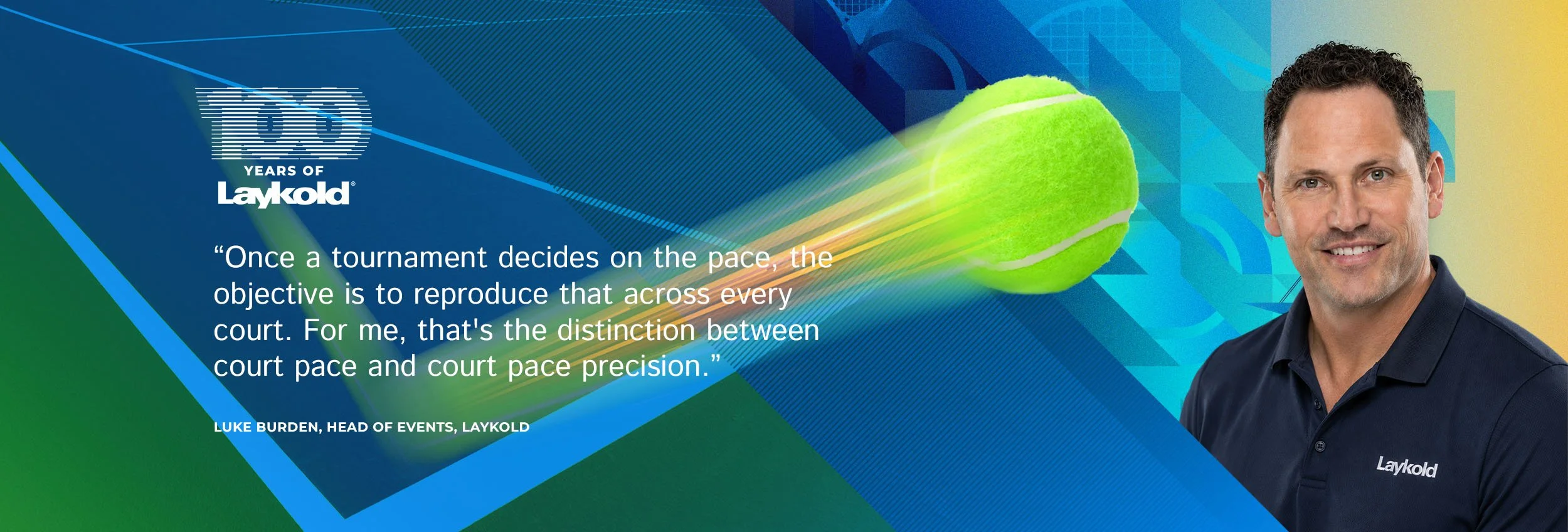
With the US Open underway on Laykold, we sat down with Luke Burden, Laykold’s Head of Events, to discuss one of the most influential, but often least understood, elements of elite tennis: court pace precision and consistency.
Luke has spent his career across multiple levels of the tennis industry, from playing and coaching to leading tennis academies, directing tournaments, working with national federations and supporting professional events around the world.
Today, he works closely with professional tournaments to help ensure that the playing surface provides the consistency and performance required at the highest level of the sport.
Luke, people often describe a tennis court simply as "fast" or "slow." Is that really the most important consideration?
Not necessarily. I think variation in court speed is important for tennis. Different tournaments should have different playing characteristics. It creates identity, rewards different styles of play and is part of what makes the sport so interesting.
The more important question is whether the pace is intentional, precise and consistent.
Once a tournament decides on the pace it wants their courts, the objective should be to reproduce that across every court as accurately as possible. For me, that's the distinction between court pace and court pace precision.
Why can relatively small variations matter to an elite player?
Professional tennis operates in milliseconds and millimetres. Players are returning serves travelling at more than 100 mph, taking the ball incredibly early and making complex decisions instinctively.
At that level, players and their teams work extremely hard to control the variables they can control. They fine-tune rackets, strings and string tension. They manage nutrition, recovery, sleep and preparation in extraordinary detail.
The court is another fundamental part of that performance environment because virtually every point involves repeated interactions between the ball and the playing surface.
The average US Open rally length is 3.85 shots which means the ball interacts with the court around 800 times per match. From a performance perspective, it therefore makes sense to minimize unintended variation in those interactions.
“We can tailor court pace to approximately 0.5 CPR, giving tournaments significantly greater control over the playing characteristics they want to achieve.”
Does that become even more important with today's leading players?
Absolutely.
Look at players such as Jannik Sinner, Carlos Alcaraz and Aryna Sabalenka. They're different players, but all three demonstrate how important timing is in modern attacking tennis.
Sinner takes the ball exceptionally early and removes time from his opponent. Alcaraz combines explosive attacking tennis with extraordinary variety and the ability to change the shape of a point almost instantly. Sabalenka generates enormous power and frequently looks to establish control through the serve and first ball.
When you're taking the ball early, redirecting significant pace or looking to dominate the first few shots of a rally, consistency matters. Small variations in the ball's interaction with the surface can influence timing, contact point and execution.
A predictable court gives players greater confidence in their movement and timing. It allows them to trust the thousands of hours of training that have developed those patterns and reactions
Of course, these are some of the best players in the world, so you expect them to win on many different surfaces. But it's still interesting to see aggressive, first-strike tennis performing so successfully at major events on Laykold such as the US Open, Miami and Indian Wells.
The ITF already has a Court Pace Rating system. Where do you see the opportunity for greater precision?
The ITF testing methodology gives tennis an established way of objectively measuring court pace. That's extremely valuable. The opportunity, in my view, is to look beyond broad classification and focus increasingly on precision within those classifications.
At recreational level, that difference may not be particularly significant. At professional level, where margins are extremely small, greater precision becomes much more relevant.
Our work at Laykold has focused on understanding those margins and developing the ability to engineer court pace with a very high degree of accuracy. We can tailor court pace to approximately 0.5 CPR, giving tournaments significantly greater control over the playing characteristics they want to achieve.
For me, that's where the conversation should be heading, not simply asking whether a court is "medium" or "medium-fast," but asking how accurately we can deliver the performance characteristics the tournament has selected.
Does greater consistency mean you ultimately want every tournament to play the same?
Definitely not. That would take something away from tennis. Miami doesn't need to play like Indian Wells, and Indian Wells doesn't need to play like the US Open.
I've spent virtually my entire life in tennis, and one of the things I've always loved about the sport is its variety. Different conditions create different tactical challenges and give tournaments their own identity.
The goal isn't standardization. The goal is precision.
The tournament should decide how it wants its courts to perform. Our responsibility is to understand that objective and deliver it as accurately and consistently as possible across the venue.
Ultimately, what does greater court pace precision give the sport?
It allows the players to determine the tennis. We want Sinner to have the confidence to step inside the baseline. We want Alcaraz to attack, improvise and change the geometry of a point. We want Sabalenka to commit fully to her power.
The court shouldn't dictate those decisions through unintended variation. We’re trying to give the world's best players a court they can trust, and you give them the freedom to fully execute their game.
And when the world's best can perform at their highest level, tennis becomes better for the players, coaches, tournaments, broadcasters and, ultimately, the fans.
Contact a court expert
Please contract us if you have general question about our court products or services, or if want to upgrade your club, school or private facility to U.S. Open standards? We also welcome enquires from installers wishing to grow their business with Laykold.