
Interview with Franz Fasold of Ace Surfaces
The Ace Surfaces president on the growing market for exhibition events and temporary installations.
Franz Fasold’s journey in sports started on the handball courts of Germany, where he played professionally before earning a Master’s in Sports Science and Physical Education. His passion for performance led him to coach tennis for state federations in Germany, and in 1993, he brought that expertise to the U.S. Today, Franz runs Ace Surfaces, a leader in synthetic sports surfaces, renowned for creating courts for exhibitions and special events. He sat down with us to discuss what’s driving the growth of this space and why Laykold is his go-to surface.
Custom Nike pickleball court
We’re hearing a lot about the growth in exhibition events and temporary installations. Is this something you’ve experienced?
Yes, it’s definitely growing. From the promoters’ side, these events are profit centers. Some are traditional exhibitions that have been revived, others are brand-new events. And from the players’ side, it’s an attractive source of income at times when they’re not playing official tournaments. As long as players are healthy, they usually don’t turn down these opportunities, as it’s a nice opportunity to earn between tour events.
It’s a win-win, and as long as there’s demand and available calendar windows, the market will keep expanding.
Speaking of calendars, how’s yours shaping up for the end of 2025 and into 2026?
This December alone, we’re supplying four exhibitions in five days. We have events at the Spectrum Center Charlotte in North Carolina, the Prudential Center in New Jersey, Madison Square Garden in New York, and Marlins Park in Miami, Florida.
For next year, we’re waiting to hear from the USTA about Davis Cup or Billie Jean King Cup home ties in mid-February, which we would supply. In late February and early March, tennis players arrive in the U.S. before Indian Wells, so that’s become a reliable window for exhibitions as well. There’s an event at the MGM in Las Vegas in early March, and Pickle Slam 4 in April at the Hard Rock Café in Miami. Promoters of December events usually rebook a year ahead, so the calendar fills early.
Temporary installation pickleball court at the MGM Grand arena in Las Vegas
For those unfamiliar with these events, how long does a typical event like these last?
Usually it’s a one-evening event, starting around 7 p.m. and ending around 10 or 10:30. These events are perfect for people attending after work or school. For us, the goal is to remove the entire floor the same night if the venue has an event the next day. If the arena is empty the following day, we’ll do the breakdown in the morning to avoid overtime costs. When we do need to pack out the same night, and it takes about four hours to get everything onto the truck.
“This December alone, we’re supplying four exhibitions in five days.”
Charlotte Invitational - Spectrum Center, Charlotte, North Carolina
Are most of your temporary installations indoors?
Almost all of them. Our portable courts are built on wooden floors, which you don’t want exposed to weather. You could use them outdoors only if perfectly protected from the elements.
Where do most of your installations take place?
We’ve worked all over the country – California, Reno, Las Vegas, Asheville, San Antonio, New York. But recently there’s been a shift toward the East Coast, especially with the current cluster of events in Miami, Charlotte, New Jersey, and New York. For USTA events, the organization selects venues they consider strong tennis markets.
From an installer’s perspective, what makes a temporary court successful?
There are three things that are key, for me.
The first is the speed of installation and breakdown. If an installation takes one or two days, promoters have to book the arena for that entire time, and that’s expensive. So the system must go down and come up quickly.
The second thing is player safety and comfort. These are professional players, so the surface absolutely has to be consistent, safe, and trustworthy. That’s a major reason we use Laykold exclusively – because we know the quality.
And then there’s color and branding options because many exhibitions have themes or sponsors, and color schemes are important. Laykold gives us the flexibility to meet every one of these requirements.
The Garden Cup tennis event temporary installation
So when it comes to temporary courts, reliability is key?
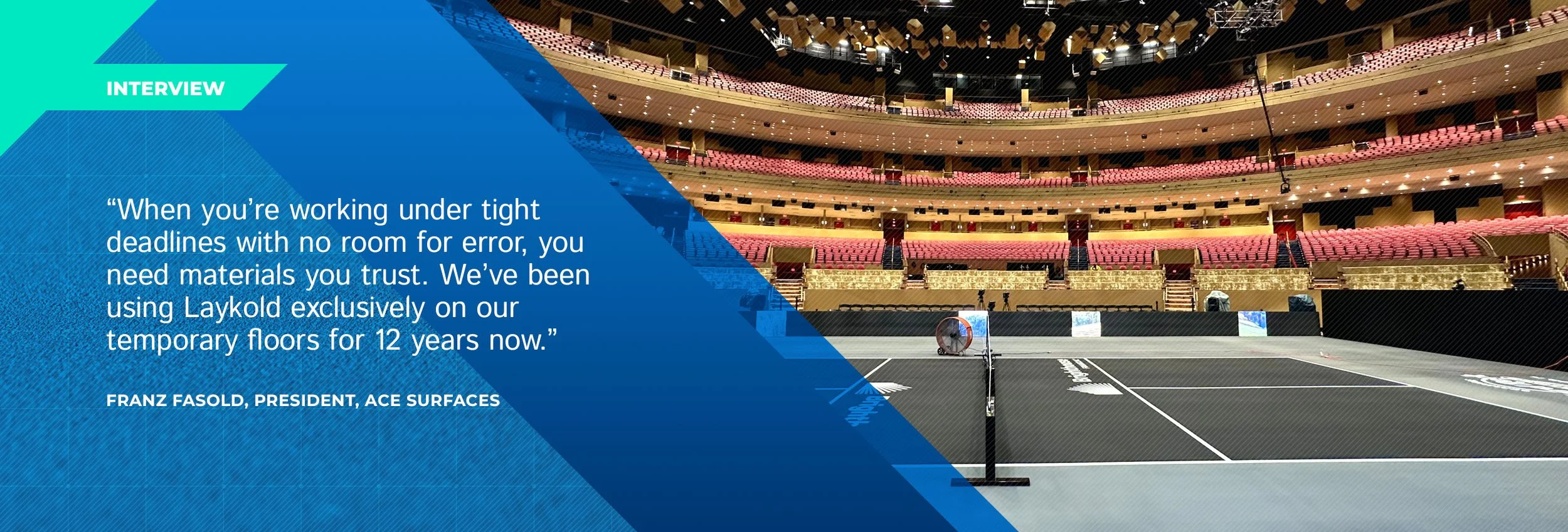
Yes, and we know exactly how the Laykold systems and materials behave. The supply is dependable, the performance is consistent, and we don’t have unpleasant surprises. When you’re working under tight deadlines with no room for error, you need materials you trust. We’ve been using Laykold exclusively on our temporary floors for 12 years now.
Over the years we’ve developed a very streamlined system for every detail of these installations: how the trucks are packed, how we stage the materials, where we start and finish, how we handle nets and accessories. Because it’s not just us working – these installations happen alongside TV crews, LED-wall teams, arena staff and others, so our process needs to be efficient and predictable.
Are there particular venues that are more challenging than others?
Madison Square Garden is certainly one of the most challenging. Getting large trucks into Manhattan on a strict schedule can be stressful. You might be given a one-hour window, and freight companies must understand the consequences of being late. We’ve supplied MSG numerous times and it’s very important to work closely with the arena operators, who do this every day, and to have good communication.
Plus, there are space limitations and union labor rules that add to the complexity. A lot of puzzle pieces have to fit together to make for a seamless installation. That’s why you want to work with a reliable surface in the first place, like Laykold.